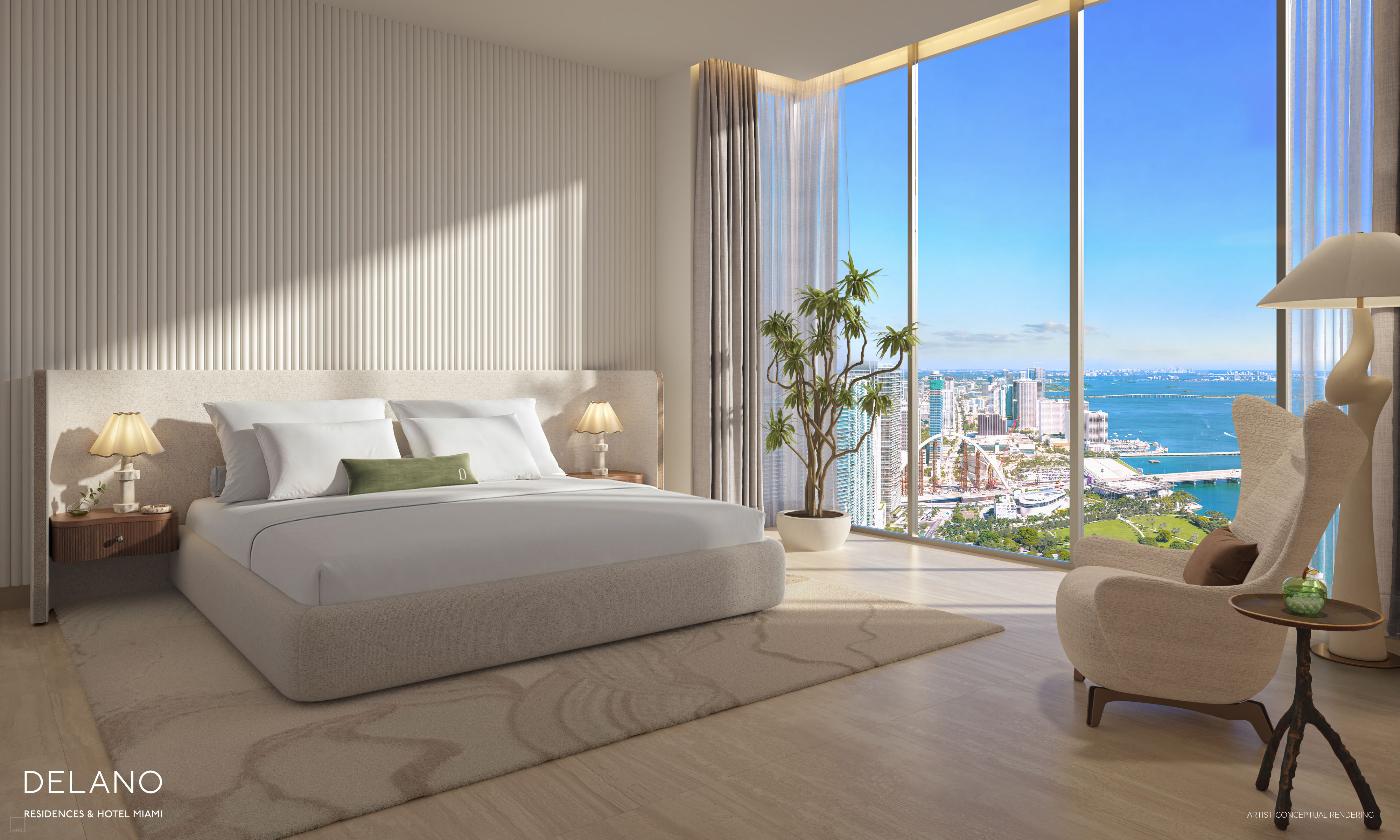
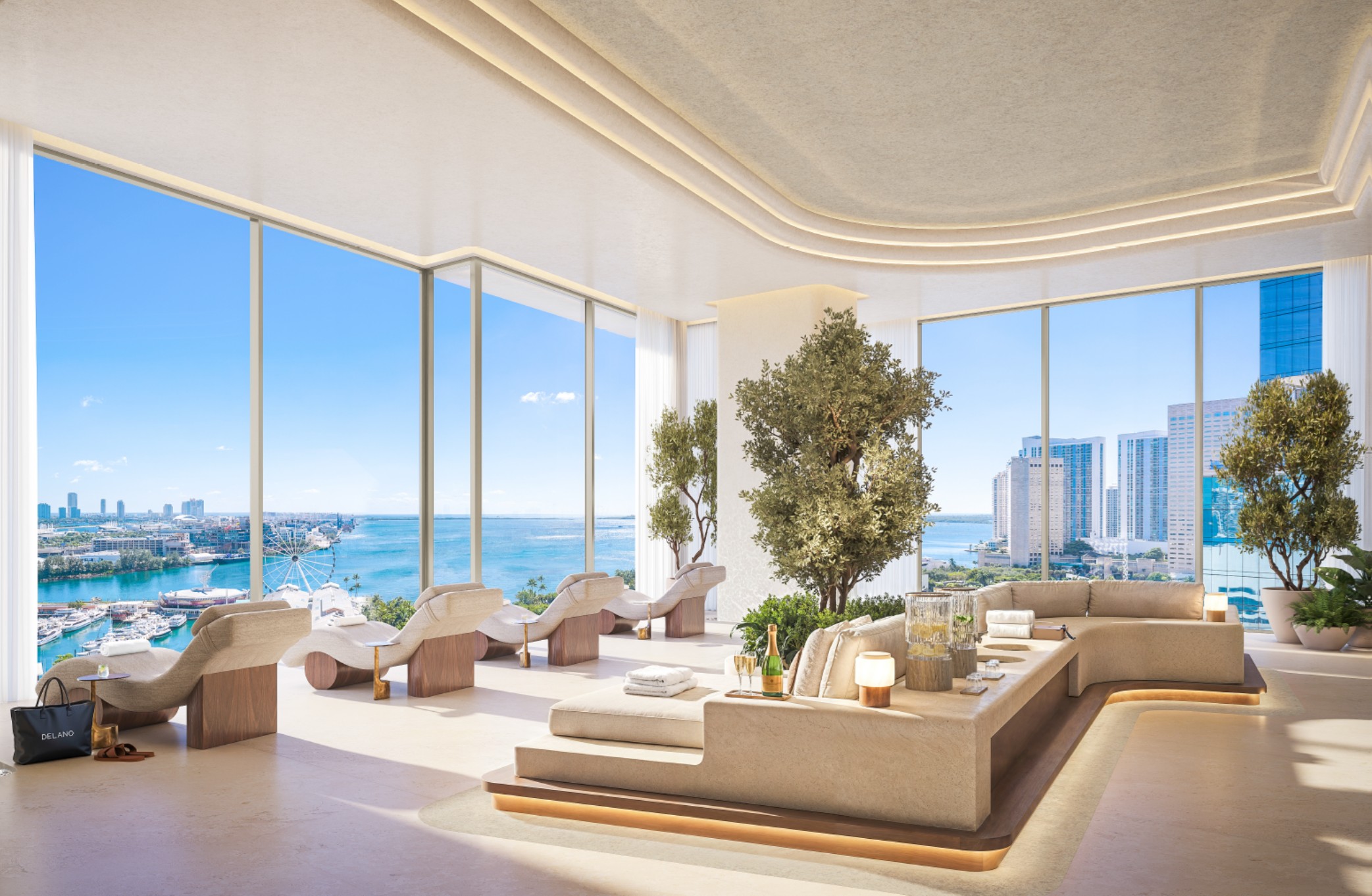
850 Feet Above the World: The View That Changes Everything
850 Pies Sobre el Mundo: La Vista Que lo Cambia Todo
850 Piedi Sopra il Mondo: La Vista Che Cambia Tutto
850 Pés Acima do Mundo: A Vista Que Muda Tudo
By Dora Kovacs · January 2026 · 7 min read
Por Dora Kovacs · Enero 2026 · 7 min de lectura
Di Dora Kovacs · Gennaio 2026 · lettura di 7 min
Por Dora Kovacs · Janeiro 2026 · leitura de 7 min
Miami has always sold a view. From the original Versailles-on-the-Atlantic mansions of the 1920s to the Collins Avenue oceanfront towers that defined the city in the decades that followed, the pitch has always ended the same way: look out. But at Delano Residences & Hotel Miami — from the private observation deck that crowns the 90-story supertall tower — the invitation shifts. Here, the view does not merely present Miami. It presents the curvature of the earth.
Miami siempre ha vendido una vista. Pero en Delano Residencias & Hotel Miami —desde la plataforma de observación privada que corona la torre supertall de 90 pisos— la invitación cambia. Aquí, la vista no simplemente presenta Miami. Presenta la curvatura de la tierra.
Miami ha sempre venduto una vista. Dalle originali ville Versailles-on-the-Atlantic degli anni Venti alle torri oceanfront di Collins Avenue che hanno definito la città nei decenni successivi, il pitch è sempre finito nello stesso modo: guarda fuori. Ma a Delano Residences & Hotel Miami — dal deck di osservazione privato che corona la torre supertall di 90 piani — l'invito cambia. Qui, la vista non presenta semplicemente Miami. Presenta la curvatura della terra.
Miami sempre vendeu uma vista. Das originais mansões Versailles-on-the-Atlantic dos anos 1920 às torres oceanfront de Collins Avenue que definiram a cidade nas décadas seguintes, o argumento sempre terminou do mesmo jeito: olhe para fora. Mas em Delano Residences & Hotel Miami — a partir do deck de observação privado que coroa a torre supertall de 90 andares — o convite muda. Aqui, a vista não apenas apresenta Miami. Apresenta a curvatura da terra.
Miami's First Private Observation Deck
La Primera Plataforma de Observación Privada de Miami
Il Primo Deck di Osservazione Privato di Miami
O Primeiro Deck de Observação Privado de Miami
There are a handful of skyscrapers in the world with publicly accessible observation decks — the Empire State, the Burj Khalifa, Taipei 101. They are crowded, ticketed, filtered through gift shops and elevator queues. What Delano offers is something else entirely: a private observation deck, reserved exclusively for the residents and guests of this single building, situated at an elevation — 850 feet above mean sea level — that has, until now, simply not existed on the Miami skyline.
Hay un puñado de rascacielos en el mundo con plataformas de observación accesibles al público — el Empire State, el Burj Khalifa, Taipei 101. Son concurridos, con boletos, filtrados a través de tiendas de regalos y filas de ascensores. Lo que Delano ofrece es algo completamente diferente: una plataforma de observación privada, reservada exclusivamente para los residentes y huéspedes de este único edificio.
Ci sono una manciata di grattacieli nel mondo con piattaforme di osservazione pubblicamente accessibili — l'Empire State, il Burj Khalifa, Taipei 101. Sono affollati, a pagamento, filtrati attraverso negozi di souvenir e code di ascensori. Quello che Delano offre è qualcosa di completamente diverso: una piattaforma di osservazione privata, riservata esclusivamente ai residenti e agli ospiti di questo unico edificio, situata a un'elevazione — 850 piedi sopra il livello medio del mare — che, fino ad ora, semplicemente non è esistita sullo skyline di Miami.
Há um punhado de arranha-céus no mundo com decks de observação publicamente acessíveis — o Empire State, o Burj Khalifa, Taipei 101. Eles são lotados, com ingressos, filtrados por lojas de presentes e filas de elevadores. O que Delano oferece é algo completamente diferente: um deck de observação privado, reservado exclusivamente para os residentes e convidados deste único edifício, situado em uma elevação — 850 pés acima do nível médio do mar — que, até agora, simplesmente não existiu no horizonte de Miami.
To understand why this matters, it helps to know how rare supertall buildings are in the Americas. A "supertall" is defined by the Council on Tall Buildings and Urban Habitat as any structure exceeding 300 meters, roughly 984 feet. There are fewer than two dozen in the Western Hemisphere. Of those, Delano is the only one that places an observation deck at the very top and reserves it for a single residential community. The math is unsentimental: the number of people who will ever stand at this altitude, in this city, in this way, is vanishingly small.
Para entender por qué esto importa, ayuda saber qué tan raros son los edificios supertall en las Américas. Un "supertall" es definido como cualquier estructura que supere los 300 metros, aproximadamente 984 pies. Hay menos de dos docenas en el Hemisferio Occidental. De esos, Delano es el único que coloca una plataforma de observación en la parte superior y la reserva para una sola comunidad residencial.
Per capire perché questo sia importante, è utile sapere quanto rare siano gli edifici supertall nelle Americhe. Un "supertall" è definito dal Consiglio su Edifici Alti e Habitat Urbano come una struttura che supera i 300 metri, approssimativamente 984 piedi. Ce ne sono meno di due dozzine nell'Emisfero Occidentale. Tra questi, Delano è l'unica che colloca un ponte di osservazione proprio in cima e lo riserva a una singola comunità residenziale. La matematica è spietata: il numero di persone che mai staranno a questa altitudine, in questa città, in questo modo, è straordinariamente piccolo.
Para entender por que isso importa, é útil saber como são raros os edifícios supertall nas Américas. Um "supertall" é definido pelo Conselho de Edifícios Altos e Habitat Urbano como uma estrutura que excede 300 metros, aproximadamente 984 pés. Há menos de duas dúzias no Hemisfério Ocidental. Desses, Delano é o único que coloca um terraço de observação bem no topo e o reserva para uma única comunidade residencial. A matemática é impiedosa: o número de pessoas que jamais ficarão nesta altitude, nesta cidade, desta forma, é imensamente pequeno.
"We wanted to give residents something the city itself cannot offer. A view that changes every hour, every season, every year, and that belongs — in the truest sense — only to them."
— From the Architectural Brief, PMG Residential
"Queríamos darle a los residentes algo que la ciudad misma no puede ofrecer. Una vista que cambia cada hora, cada temporada, cada año, y que pertenece —en el sentido más verdadero— solo a ellos."
— Del Brief Arquitectónico, PMG Residential
850ft
Observation Deck Elevation
Elevación de la Plataforma
Elevazione della Piattaforma di Osservazione
Elevação do Deck de Observação
40mi
Horizon Visible on Clear Days
Horizonte Visible en Días Claros
Orizzonte Visibile nei Giorni Sereni
Horizonte Visível em Dias Claros
1
Private Observation Deck in the Americas
Plataforma Privada en las Américas
Ponte di Osservazione Privata nelle Americhe
Terraço de Observação Privado nas Américas
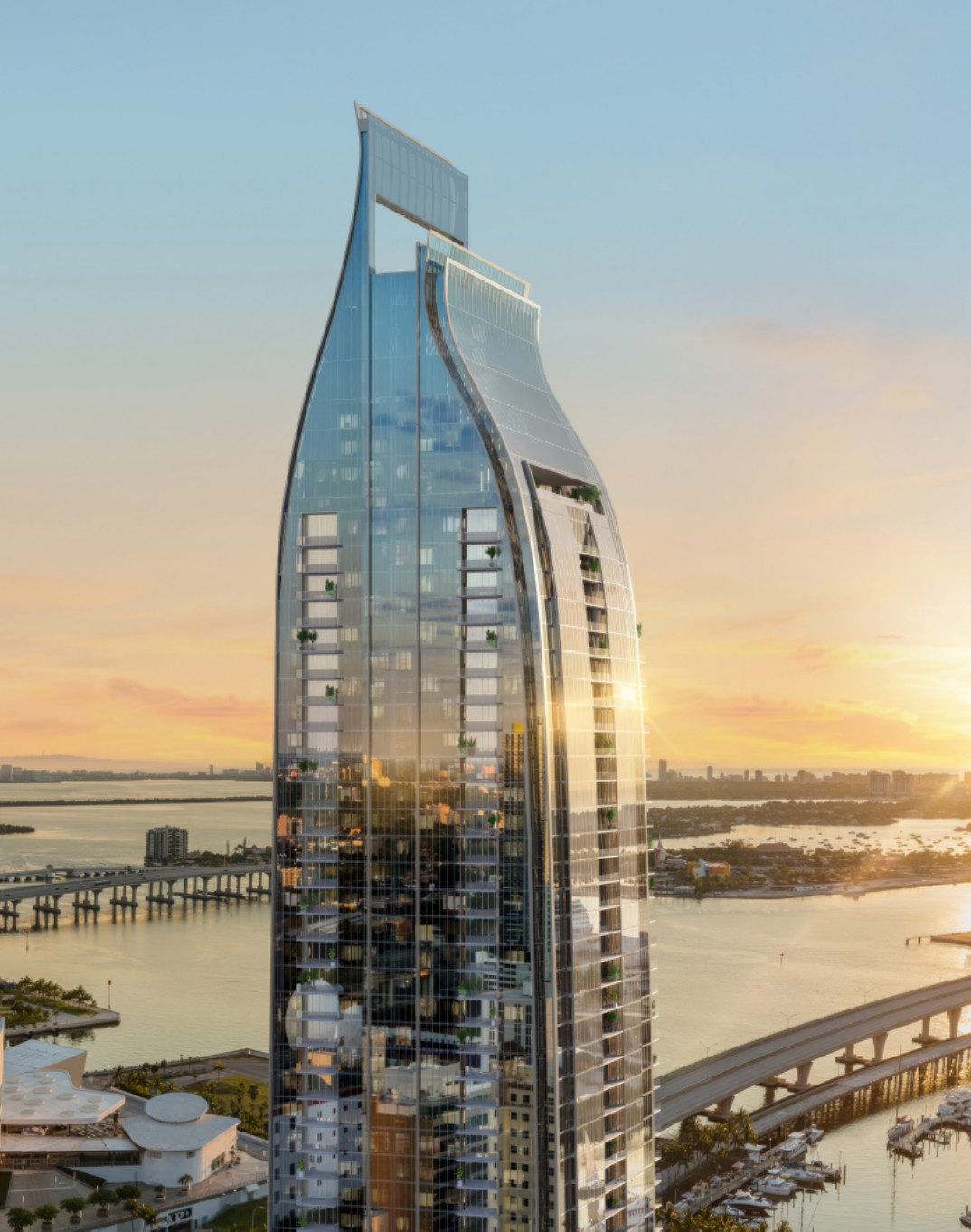
The Delano tower from a quarter-mile out — its final 200 feet of glass and steel dedicated to the pool, sky restaurant, and private observation deck.La torre Delano a un cuarto de milla de distancia — sus últimos 200 pies de vidrio y acero dedicados a la piscina, el restaurante del cielo y la plataforma de observación privada.
What You See
Lo Que Ves
Quello Che Vedi
O Que Você Vê
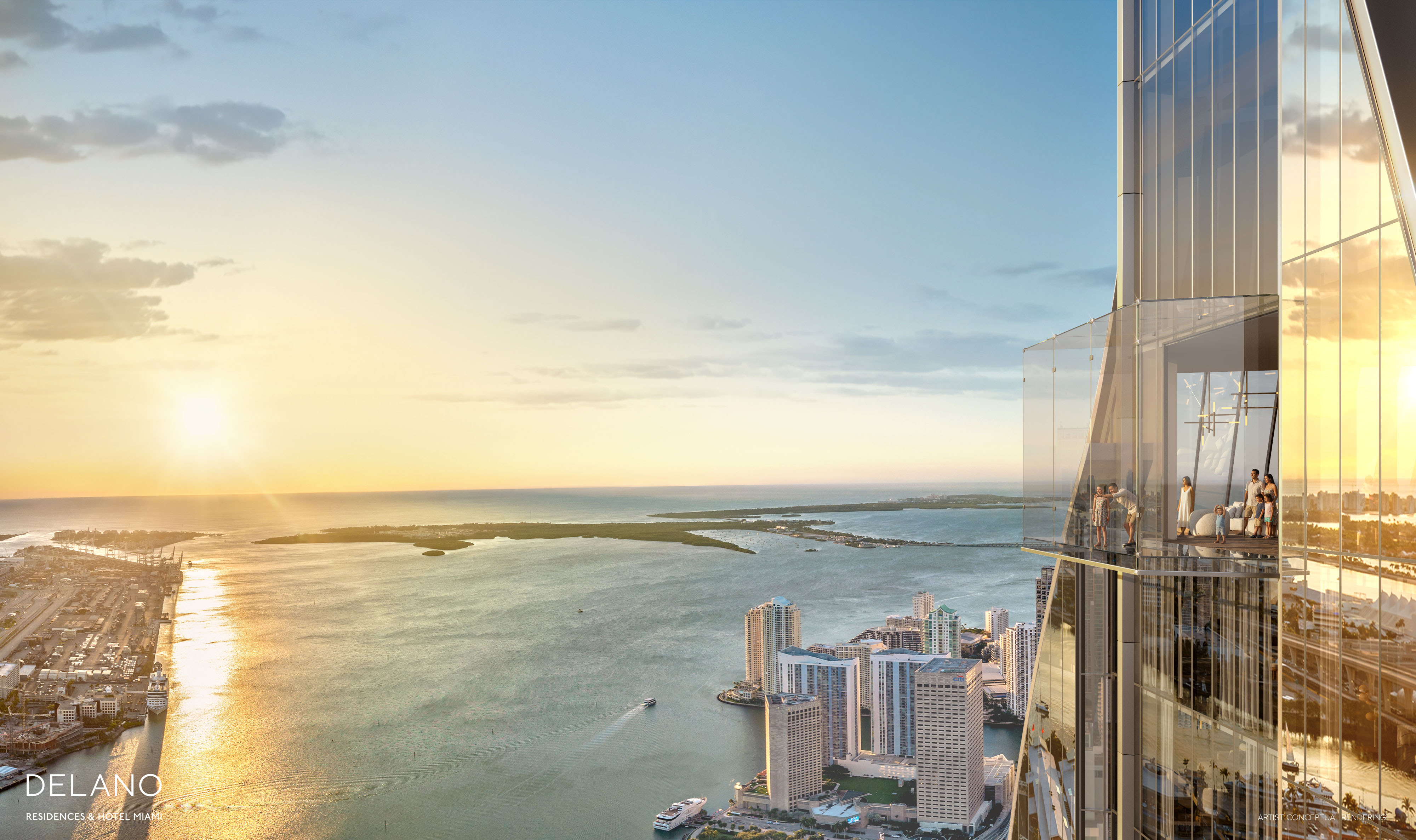
From the deck, Miami reveals itself as a map rather than a city. The grid of downtown below resolves into a perfect orthogonal pattern, the kind of clarity only possible when viewed from above. To the east, the Atlantic stretches without interruption to the horizon — the line itself clearly curved on the brightest days. To the south, Biscayne Bay spreads like polished glass, dotted with yachts that appear, from this altitude, as scattered coins.
Desde la plataforma, Miami se revela como un mapa más que como una ciudad. La cuadrícula del centro abajo se resuelve en un patrón ortogonal perfecto, el tipo de claridad solo posible cuando se ve desde arriba. Hacia el este, el Atlántico se extiende sin interrupción hasta el horizonte —la línea misma claramente curvada en los días más brillantes.
Dal ponte, Miami si rivela come una mappa piuttosto che come una città. La griglia del centro sottostante si risolve in un perfetto modello ortogonale, il tipo di chiarezza possibile solo quando visualizzato da sopra. A est, l'Atlantico si estende senza interruzioni all'orizzonte — la linea stessa chiaramente curva nei giorni più luminosi. A sud, Biscayne Bay si estende come vetro lucido, punteggiata da yacht che sembrano, da questa altitudine, come monete sparse.
Do convés, Miami se revela como um mapa em vez de uma cidade. A grade do centro abaixo se resolve em um padrão ortogonal perfeito, o tipo de clareza possível apenas quando visto de cima. A leste, o Atlântico se estende sem interrupção até o horizonte — a linha em si claramente curva nos dias mais brilhantes. Ao sul, Biscayne Bay se estende como vidro polido, pontilhado de iates que parecem, dessa altitude, como moedas espalhadas.
To the west, the Everglades begin their slow march into the Gulf, a distant emerald line that reminds you how close Miami still is to genuine wilderness. To the north, the Miami Beach peninsula sits suspended between two waters, its pastel facades softened by distance into a kind of continuous reef of color. On the clearest winter mornings, when the air has that particular dry quality Florida produces after a front passes through, residents have reported seeing as far as Key Largo — more than forty miles south.
Hacia el oeste, los Everglades comienzan su lenta marcha hacia el Golfo, una distante línea esmeralda que te recuerda qué tan cerca está aún Miami de la auténtica naturaleza. Hacia el norte, la península de Miami Beach se encuentra suspendida entre dos aguas. En las mañanas de invierno más claras, los residentes han reportado ver hasta Key Largo — más de cuarenta millas al sur.
A ovest, l'Everglades inizia la sua lenta marcia nel Golfo, una linea di smeraldo distante che ti ricorda quanto Miami sia ancora vicina alla vera natura selvaggia. A nord, la penisola di Miami Beach si siede sospesa tra due acque, le sue facciate pastel ammorbidite dalla distanza in una sorta di barriera corallina continua di colore. Nelle più chiare mattinate invernali, quando l'aria ha quella particolare qualità secca che la Florida produce dopo il passaggio di un fronte, i residenti hanno riferito di aver visto fino a Key Largo — più di quaranta miglia a sud.
Para o oeste, os Everglades começam sua marcha lenta para o Golfo, uma linha de esmeralda distante que te lembra o quão perto Miami ainda está da verdadeira natureza selvagem. Ao norte, a península de Miami Beach fica suspensa entre duas águas, suas fachadas pastel suavizadas pela distância em uma espécie de recife contínuo de cor. Nas manhãs de inverno mais claras, quando o ar tem aquela qualidade seca particular que a Flórida produz após a passagem de uma frente, os residentes relataram ver tão longe quanto Key Largo — mais de quarenta milhas ao sul.
The Light Changes Everything
La Luz lo Cambia Todo
La Luce Cambia Tutto
A Luz Muda Tudo
If the view is the first subject of the observation deck, the light is the second. Miami is — as photographers and painters have understood for a century — a city defined by an unusually theatrical quality of natural light. The combination of latitude, humidity, and proximity to two bodies of water produces morning skies that seem to blush from horizon to horizon, midday brilliance that turns white stone almost luminous, and sunsets that do not simply color the clouds but appear to ignite them.
Si la vista es el primer sujeto de la plataforma de observación, la luz es el segundo. Miami es — como los fotógrafos y pintores han entendido durante un siglo — una ciudad definida por una calidad inusualmente teatral de luz natural.
Se la vista è il primo soggetto della terrazza di osservazione, la luce è il secondo. Miami è — come fotografi e pittori hanno capito per un secolo — una città definita da una qualità inusualmente teatrale di luce naturale. La combinazione di latitudine, umidità e prossimità a due corpi idrici produce cieli mattutini che sembrano arrossire da orizzonte a orizzonte, brillantezza di mezzogiorno che trasforma la pietra bianca quasi luminosa, e tramonti che non semplicemente colorano le nuvole ma sembrano infiammarle.
Se a vista é o primeiro assunto do deck de observação, a luz é o segundo. Miami é — como fotógrafos e pintores compreenderam por um século — uma cidade definida por uma qualidade inusualmente teatral de luz natural. A combinação de latitude, umidade e proximidade a dois corpos de água produz céus matinais que parecem corar de horizonte a horizonte, brilho ao meio-dia que torna a pedra branca quase luminosa, e pôr do sol que não simplesmente colorem as nuvens, mas parecem inflamá-las.
At 850 feet, you are not simply watching these phenomena from below. You are inside them. The morning sun does not rise over the ocean; it rises through the deck itself. Afternoon thunderheads that would blanket the city from street-level appear, from above, as distinct architectural objects — their vertical shafts of rain like columns holding up an impossible cathedral. And the sunset hour, which Miami has been mythologizing in literature and film for decades, becomes something close to a religious experience.
A 850 pies, no estás simplemente observando estos fenómenos desde abajo. Estás dentro de ellos. El sol de la mañana no se eleva sobre el océano; se eleva a través de la plataforma misma. Las cabezas de tormenta de la tarde que cubrirían la ciudad desde el nivel de la calle aparecen, desde arriba, como objetos arquitectónicos distintos.
A 850 piedi, non stai semplicemente guardando questi fenomeni da sotto. Sei dentro di loro. Il sole del mattino non sorge sull'oceano; sorge attraverso il ponte stesso. Le celle temporalesche del pomeriggio che avvolgerebbero la città dal livello della strada, da sopra, appaiono come oggetti architettonici distinti — i loro shaft verticali di pioggia come colonne che reggono una cattedrale impossibile. E l'ora del tramonto, che Miami ha mitologizzato nella letteratura e nel film per decenni, diventa qualcosa di simile a un'esperienza religiosa.
A 850 pés, você não está simplesmente observando esses fenômenos de baixo. Você está dentro deles. O sol da manhã não nasce sobre o oceano; nasce através do próprio convés. As células de tempestade da tarde que cobriria a cidade do nível da rua, de cima, aparecem como objetos arquitetônicos distintos — seus eixos verticais de chuva como colunas segurando uma catedral impossível. E a hora do pôr do sol, que Miami tem mitologizado na literatura e no cinema por décadas, torna-se algo próximo a uma experiência religiosa.
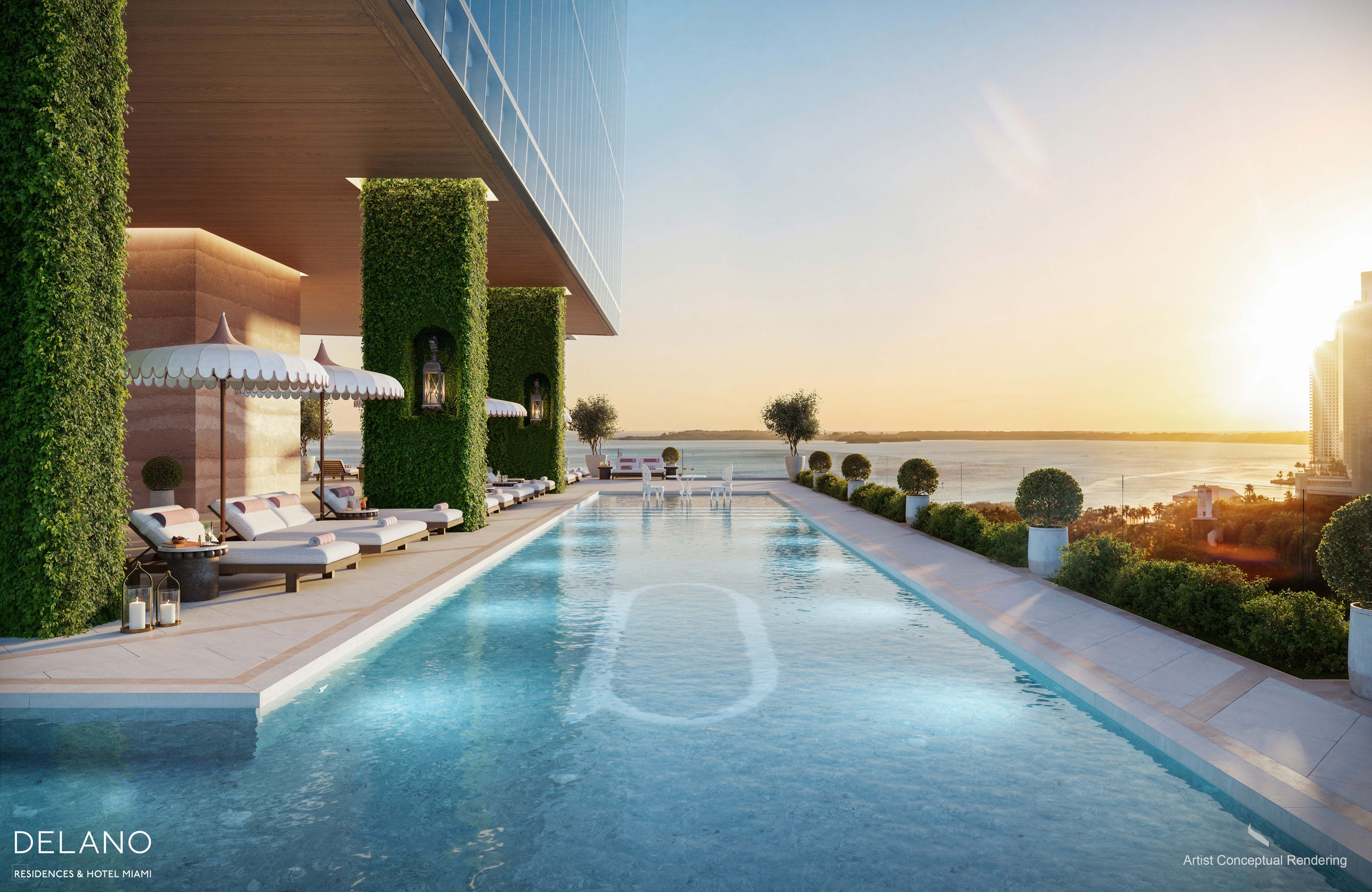
The sky pool, one level below the observation deck at 800 feet, offers perhaps the only swimmable altitude of its kind in the Americas.La piscina en el cielo, un nivel debajo de la plataforma de observación a 800 pies, ofrece quizás la única altitud nadable de su tipo en las Américas.
A Private Choreography
Una Coreografía Privada
Una Coreografia Privata
Uma Coreografia Privada
What separates the Delano deck from every other high-altitude observation space in the world is its scale and its silence. There are no crowds. No announcements. No guided tours. Access is controlled by a residential key fob, and capacity — by intentional design — is limited. On any given afternoon, a resident might find themselves the only person on the deck, or share it with a handful of neighbors conducting their own quiet rituals: morning coffee, late-afternoon yoga, evening cocktails staged for the sunset.
Lo que separa la plataforma Delano de cualquier otro espacio de observación de alta altitud en el mundo es su escala y su silencio. No hay multitudes. No hay anuncios. No hay recorridos guiados. El acceso es controlado por un llavero residencial, y la capacidad —por diseño intencional— es limitada.
Ciò che distingue il deck di Delano da ogni altro spazio di osservazione ad alta quota nel mondo è la sua scala e il suo silenzio. Non ci sono folle. Nessun annuncio. Nessun tour guidato. L'accesso è controllato da un telecomando residenziale e la capacità — per progettazione intenzionale — è limitata. In qualsiasi pomeriggio, un residente potrebbe trovarsi ad essere l'unica persona sul deck, oppure condividerlo con una manciata di vicini che conducono i loro stessi rituali silenziosi: caffè mattutino, yoga del tardo pomeriggio, cocktail serali allestiti per il tramonto.
O que separa o deck de Delano de qualquer outro espaço de observação em alta altitude no mundo é sua escala e seu silêncio. Não há multidões. Nenhum anúncio. Nenhum tour guiado. O acesso é controlado por um chaveiro residencial, e a capacidade — por design intencional — é limitada. Em qualquer tarde, um residente pode se ver como a única pessoa no deck, ou compartilhá-lo com alguns vizinhos conduzindo seus próprios rituais silenciosos: café da manhã, yoga no final da tarde, coquetéis noturnos encenados para o pôr do sol.
The deck is engineered for private gatherings of thirty to fifty residents — a dinner under the stars, a birthday held above the clouds, a New Year's Eve from which you watch the fireworks not from below but from eye level. Delano's concierge team can arrange the details: a cellist from the Miami Symphony, a sommelier from Eleven Madison Park alumni, a caviar service drawn from the hotel's cellar twenty floors below. The effect is of a private party held at the apex of one of the most recognizable skylines in the world, with the city itself as an uninvited but deeply impressed guest.
La plataforma está diseñada para reuniones privadas de treinta a cincuenta residentes — una cena bajo las estrellas, un cumpleaños celebrado sobre las nubes, una víspera de Año Nuevo desde la cual ves los fuegos artificiales no desde abajo sino al nivel de los ojos.
Il deck è ingegnerizzato per riunioni private di trenta a cinquanta residenti — una cena sotto le stelle, un compleanno tenuto sopra le nuvole, una vigilia di Capodanno da cui guardi i fuochi d'artificio non da sotto ma a livello degli occhi. Il team di concierge del Delano può organizzare i dettagli: un violoncellista dalla Miami Symphony, un sommelier dai laureati di Eleven Madison Park, un servizio di caviale tratto dalla cantina dell'hotel venti piani più in basso. L'effetto è di una festa privata tenuta all'apice di uno degli skyline più riconoscibili del mondo, con la città stessa come ospite non invitato ma profondamente impressionato.
O deck é engenhariado para reuniões privadas de trinta a cinquenta residentes — um jantar sob as estrelas, um aniversário celebrado acima das nuvens, uma véspera de Ano Novo de onde você assiste aos fogos de artifício não de baixo, mas ao nível dos olhos. A equipe de concierge do Delano pode organizar os detalhes: um violoncelista da Miami Symphony, um sommelier dos alunos de Eleven Madison Park, um serviço de caviar extraído da adega do hotel vinte andares abaixo. O efeito é de uma festa privada realizada no ápice de um dos horizonte mais reconhecíveis do mundo, com a própria cidade como convidada não convidada, mas profundamente impressionada.
"At 850 feet, Miami is no longer a city you live in. It is a city you preside over."
"A 850 pies, Miami ya no es una ciudad en la que vives. Es una ciudad sobre la que presides."
"A 850 piedi, Miami non è più una città in cui vivi. È una città su cui presidi."
"A 850 pés, Miami não é mais uma cidade em que você vive. É uma cidade sobre a qual você preside."
What an Altitude Like This Actually Means
Lo Que Realmente Significa Una Altitud Como Esta
Cosa Significa Veramente Un'Altitudine Come Questa
O Que uma Altitude Assim Realmente Significa
There is an old argument in architecture that the best view from any building is not from its top but from a floor or two below — because from the absolute summit, you can no longer see the building itself, and therefore lose the frame of reference that makes the view readable. The Delano observation deck rejects this logic because it is not designed to frame Miami but to release it.
Standing here, the ordinary architectural cues fall away. There is no building in your peripheral vision. There is no ground close enough to ground you. What remains is simply the relationship between yourself and what you see: a horizon that curves, weather that operates at your elevation rather than beneath it, and the quiet certainty that, at this particular moment, you are standing higher than almost anyone else in the hemisphere. For those who make Delano their home, that certainty is not occasional. It is the new condition of daily life.
Parado aquí, las señales arquitectónicas ordinarias desaparecen. Lo que queda es simplemente la relación entre tú mismo y lo que ves: un horizonte que se curva, clima que opera a tu elevación en lugar de debajo de ella, y la silenciosa certeza de que, en este momento particular, estás parado más alto que casi cualquier otra persona en el hemisferio.
Stando qui, i segnali architettonici ordinari scompaiono. Non c'è nessun edificio nella tua visione periferica. Non c'è terra abbastanza vicina da radicalizzarti. Quel che rimane è semplicemente la relazione tra te stesso e quello che vedi: un orizzonte che si curva, il tempo che opera alla tua elevazione piuttosto che sotto di essa, e la certezza tranquilla che, in questo particolare momento, stai in piedi più alto di quasi chiunque altro nell'emisfero. Per coloro che fanno di Delano la loro casa, quella certezza non è occasionale. È la nuova condizione della vita quotidiana.
Ficando aqui, as pistas arquitetônicas comuns desaparecem. Não há nenhum edifício em sua visão periférica. Não há terra próxima o suficiente para ancorá-lo. O que permanece é simplesmente a relação entre você e o que vê: um horizonte que se curva, tempo que opera em sua elevação e não abaixo dela, e a certeza tranquila de que, neste momento particular, você está em pé mais alto do que quase mais ninguém no hemisfério. Para aqueles que fazem do Delano sua casa, essa certeza não é ocasional. É a nova condição da vida cotidiana.
Share this storyCompartirCondividi questa storiaCompartilhe esta história
Dora Kovacs is a licensed Florida real estate agent (License #3502193) affiliated with Keller Williams. She represents buyers and investors in Miami's most sought-after pre-construction and luxury condominium developments. Contact: dora@bnsluxury.com · (305) 781-0210 · 1000 5th St, Suite 202, Miami Beach, FL 33139.
Dora Kovacs es agente inmobiliaria licenciada en Florida (Licencia #3502193), afiliada a Keller Williams. Representa a compradores e inversionistas en los desarrollos de pre-construcción y condominios de lujo más codiciados de Miami. Contacto: dora@bnsluxury.com · (305) 781-0210 · 1000 5th St, Suite 202, Miami Beach, FL 33139.
Dora Kovacs è un agente immobiliare autorizzato dalla Florida (Licenza #3502193) affiliato a Keller Williams. Rappresenta acquirenti e investitori negli sviluppi di condomini di lusso e pre-costruzione più ricercati di Miami. Contatti: dora@bnsluxury.com · (305) 781-0210 · 1000 5th St, Suite 202, Miami Beach, FL 33139.
Dora Kovacs è un agente immobiliare autorizzato dalla Florida (Licenza #3502193) affiliato a Keller Williams. Rappresenta acquirenti e investitori negli sviluppi di condomini di lusso e pre-costruzione più ricercati di Miami. Contatti: dora@bnsluxury.com · (305) 781-0210 · 1000 5th St, Suite 202, Miami Beach, FL 33139.
Private Pricing Available
Precios Privados Disponibles
Prezzo Privato Disponibile
Preço Privado Disponível
Interested in Delano Residences?¿Interesado en Delano Residences?Interessato a Delano Residences?Interessado em Delano Residences?
Receive the full residence catalogue, current pricing, and available floor plans — delivered privately within minutes.
Reciba el catálogo completo de residencias, precios actuales y plantas disponibles — entregado en minutos.
Ricevi il catalogo completo delle residenze, i prezzi attuali e le planimetrie disponibili — consegnati privatamente in pochi minuti.
Receba o catálogo completo de residências, preços atuais e plantas disponíveis — entregues em privado em poucos minutos.
or fill manuallyo completar manualmenteo compila manualmenteou preencha manualmente
✓ Thank you. Your private pricing package is on its way.✓ Gracias. Su paquete de precios está en camino.✓ Grazie. Il tuo pacchetto di prezzo privato è in arrivo.✓ Obrigado. Seu pacote de preço privado está a caminho.