Italian Mastery: Inside the Italkraft Kitchens of Delano
Maestría Italiana: Dentro de las Cocinas Italkraft de Delano
Maestria Italiana: Dentro le Cucine Italkraft di Delano
Maestria Italiana: Dentro as Cozinhas Italkraft de Delano
By Dora Kovacs · December 2025 · 6 min read
Por Dora Kovacs · Diciembre 2025 · 6 min de lectura
Di Dora Kovacs · Dicembre 2025 · lettura di 6 minuti
Por Dora Kovacs · Dezembro 2025 · leitura de 6 minutos
In a great residence, the kitchen is never just a kitchen. It is the room to which everyone gravitates, the stage on which the most honest moments of a home unfold, the surface against which the rest of the architecture tests itself. At Delano Residences, every kitchen has been conceived with this understanding at its core — and executed in partnership with Italkraft, the Milan-born cabinetry atelier whose work has quietly shaped some of the finest residences in Europe and the Americas.
En una gran residencia, la cocina nunca es solo una cocina. Es la habitación hacia la cual todos gravitan, el escenario donde se desarrollan los momentos más honestos de un hogar. En Delano Residencias, cada cocina ha sido concebida con este entendimiento en su núcleo, y ejecutada en colaboración con Italkraft, el atelier de ebanistería nacido en Milán.
In una grande residenza, la cucina non è mai solo una cucina. È la stanza verso cui tutti gravitano, il palcoscenico su cui si svolgono i momenti più onesti di una casa, la superficie contro la quale il resto dell'architettura prova se stessa. Al Delano Residences, ogni cucina è stata concepita con questa comprensione al suo nucleo — ed eseguita in partnership con Italkraft, l'atelier di mobili nato a Milano il cui lavoro ha silenziosamente plasmato alcune delle più belle residenze in Europa e nelle Americhe.
Em uma grande residência, a cozinha nunca é apenas uma cozinha. É a sala para a qual todos gravitam, o palco em que os momentos mais honestos de uma casa se desdobram, a superfície contra a qual o resto da arquitetura se testa. No Delano Residences, cada cozinha foi concebida com essa compreensão em seu núcleo — e executada em parceria com Italkraft, o atelier de marcenaria nascido em Milão cujo trabalho silenciosamente moldou algumas das melhores residências na Europa e nas Américas.
Italkraft: The Quiet Standard
Italkraft: El Estándar Silencioso
Italkraft: Lo Standard Discreto
Italkraft: O Padrão Discreto
Italkraft is not a household name in the way that some kitchen brands are, and that is entirely by design. The firm — founded in the hills outside Milan in the 1990s — operates almost exclusively at the highest tier of residential architecture, supplying custom cabinetry to a select roster of developers, architects, and private clients. Its workshops produce fewer than one thousand kitchens a year. Each is made to order. None are shipped without a final inspection from the founding family.
Italkraft no es un nombre conocido de la misma manera que algunas marcas de cocinas, y eso es completamente por diseño. La firma —fundada en las colinas a las afueras de Milán en los años 1990— opera casi exclusivamente en el nivel más alto de la arquitectura residencial. Sus talleres producen menos de mil cocinas al año.
Italkraft non è un nome familiare nel modo in cui lo sono altri marchi di cucine, ed è interamente per scelta. L'azienda — fondata nelle colline fuori Milano negli anni Novanta — opera quasi esclusivamente al più alto livello dell'architettura residenziale, fornendo cabinetry personalizzata a un roster selezionato di sviluppatori, architetti e clienti privati. I suoi laboratori producono meno di mille cucine all'anno. Ognuno è fatto su ordinazione. Nessuno viene spedito senza un'ispezione finale dalla famiglia fondatrice.
Italkraft não é um nome familiar da forma como alguns marcas de cozinha são, e isso é inteiramente por design. A empresa — fundada nas colinas fora de Milão nos anos 1990 — opera quase exclusivamente no nível mais alto da arquitetura residencial, fornecendo marcenaria personalizada a um elenco selecionado de desenvolvedoras, arquitetos e clientes privados. Seus oficinas produzem menos de mil cozinhas por ano. Cada uma é feita sob encomenda. Nenhuma é enviada sem uma inspeção final da família fundadora.
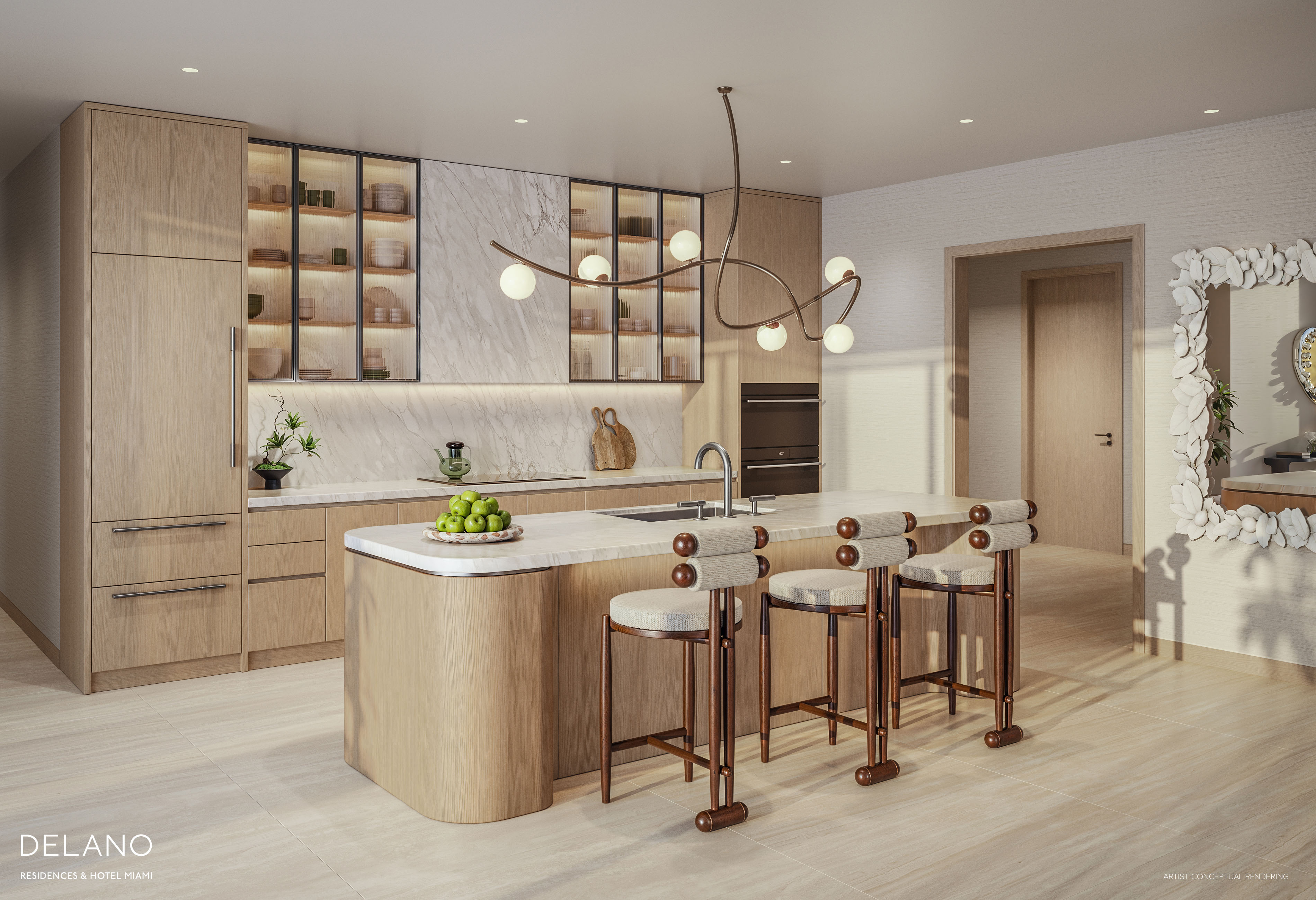
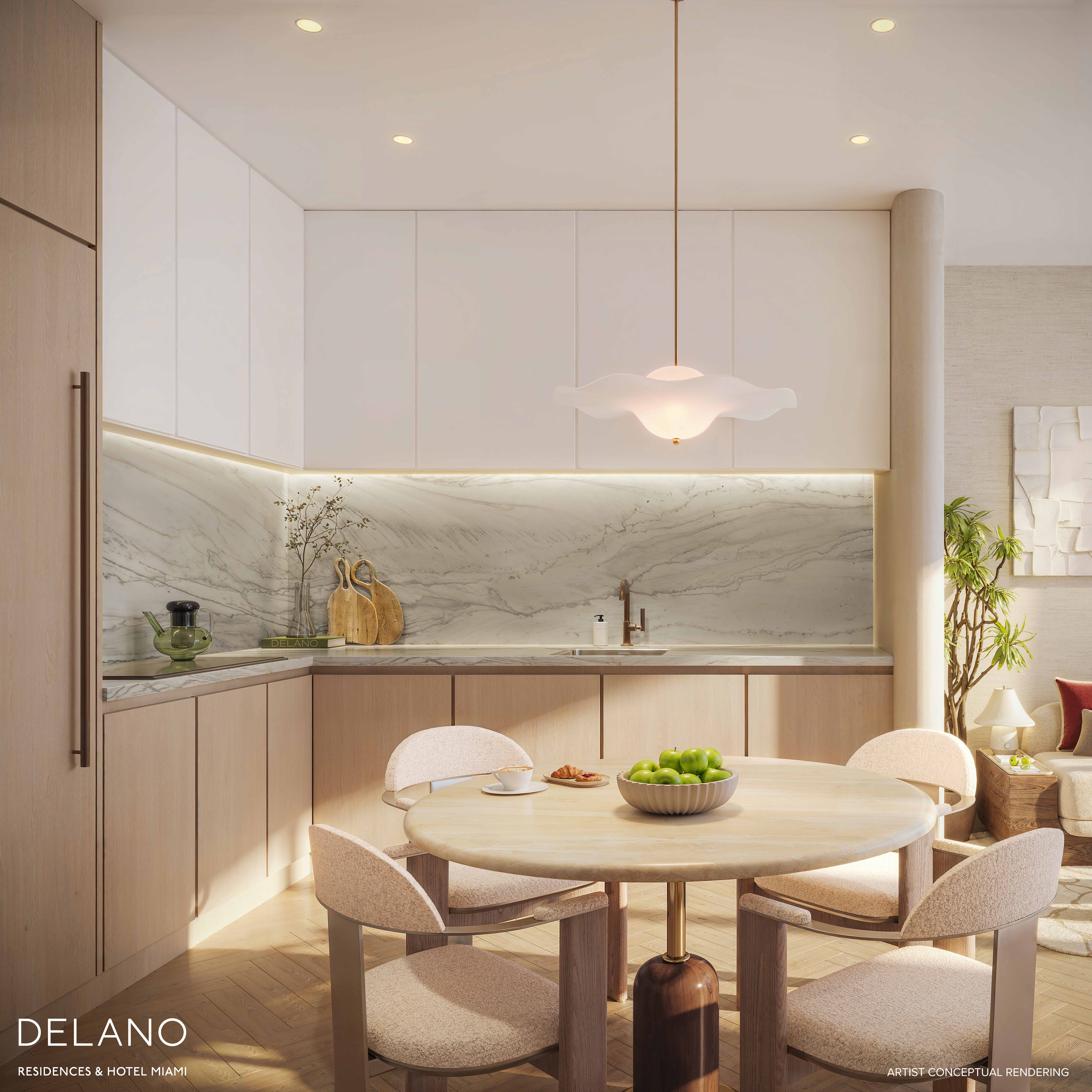
At Delano, Italkraft's work arrives as a series of architectural gestures rather than discrete appliances or cabinetry. Upper cabinets disappear into tall columns of book-matched veneer. Islands are carved from single slabs of stone — travertine in the Collection residences, volcanic basalt in the upper-floor Residences — that have been quarried, matched, and polished over months. Panel-ready doors conceal every appliance. The visual result is not a kitchen in the traditional sense but a sculpted room in which the machinery of cooking has been elevated to the level of the architecture itself.
En Delano, el trabajo de Italkraft llega como una serie de gestos arquitectónicos más que como electrodomésticos o ebanistería discreta. Los gabinetes superiores desaparecen en altas columnas de chapa contrachapada. Las islas están talladas de losas únicas de piedra —travertino en las residencias de la Colección, basalto volcánico en las Residencias de pisos superiores.
A Delano, il lavoro di Italkraft arriva come una serie di gesti architettonici piuttosto che elettrodomestici o cabinetry discreti. I mobiletti superiori scompaiono in alte colonne di impiallacciatura abbinata a libro. Le isole sono scolpite da lastre singole di pietra — travertino nelle residenze Collection, basalto vulcanico nelle Residences dei piani superiori — che sono state estratte, abbinate e lucidate nel corso di mesi. Le porte pronte per il pannello nascondono ogni elettrodomestico. Il risultato visivo non è una cucina nel senso tradizionale ma una stanza scolpita in cui la macchinaria della cucina è stata elevata al livello dell'architettura stessa.
Em Delano, o trabalho de Italkraft chega como uma série de gestos arquitetônicos em vez de eletrodomésticos discretos ou marcenaria. Os armários superiores desaparecem em altas colunas de verniz combinado em livro. As ilhas são esculpidas em lajes singelas de pedra — travertino nas residências da Collection, basalto vulcânico nas Residences dos andares superiores — que foram extraídas, combinadas e polidas ao longo de meses. As portas prontas para painéis ocultam cada eletrodoméstico. O resultado visual não é uma cozinha no sentido tradicional, mas uma sala esculpida em que a maquinaria da culinária foi elevada ao nível da própria arquitetura.
"A kitchen in a tower like this cannot be about function alone. It must be a room where a person wants to spend Saturday morning — reading, cooking, having a conversation that takes four hours. That is the test. That is the only test."
— Will Meyer, Meyer Davis
"Una cocina en una torre como esta no puede ser solo función. Debe ser una habitación donde una persona quiera pasar la mañana del sábado — leyendo, cocinando, teniendo una conversación que dura cuatro horas. Esa es la prueba. Es la única prueba."
— Will Meyer, Meyer Davis
1994
Italkraft Founded
Italkraft Fundado
Italkraft Fondata
Italkraft Fundada
100%
Italian-Made Cabinetry
Ebanistería Hecha en Italia
Mobili Italiani
Marcenaria Italiana
48in
Sub-Zero Refrigeration Standard
Refrigeración Sub-Zero Estándar
Standard di Refrigerazione Sub-Zero
Padrão de Refrigeração Sub-Zero
A Collection residence kitchen, photographed at midday. The stone island, the invisible cabinetry, the particular quality of Miami light — all of it framed to feel like a single, continuous gesture.Una cocina de residencia Collection, fotografiada al mediodía. La isla de piedra, la ebanistería invisible, la particular calidad de la luz de Miami — todo enmarcado para sentirse como un solo gesto continuo.
The Appliances: Sub-Zero and Wolf
Los Electrodomésticos: Sub-Zero y Wolf
Gli Elettrodomestici: Sub-Zero e Wolf
Os Eletrodomésticos: Sub-Zero e Wolf
Behind the panel-ready doors, the Delano kitchens are outfitted with the full Sub-Zero and Wolf package — an appliance suite that sits at the top of the residential market and has, for decades, defined the standard against which every other kitchen brand measures itself. The refrigeration is Sub-Zero's 48-inch integrated column system, which separates fresh and frozen air streams through independent dual compressors — the same approach used in professional culinary kitchens to preserve the structural integrity of everything from leafy greens to rare tuna.
Detrás de las puertas panel-ready, las cocinas Delano están equipadas con el paquete completo Sub-Zero y Wolf — una suite de electrodomésticos que se encuentra en la cima del mercado residencial y que, durante décadas, ha definido el estándar contra el cual se miden todas las demás marcas de cocina.
Dietro le porte pronte al pannello, le cucine Delano sono dotate del pacchetto completo Sub-Zero e Wolf — una suite di elettrodomestici che si trova in cima al mercato residenziale e ha, per decenni, definito lo standard rispetto al quale ogni altro marchio di cucina si misura. La refrigerazione è il sistema di colonna integrato da 48 pollici di Sub-Zero, che separa i flussi di aria fresca e congelata attraverso compressori duali indipendenti — lo stesso approccio utilizzato nelle cucine culinarie professionali per preservare l'integrità strutturale di tutto, da verdure a foglia verde a tonno raro.
Atrás das portas prontas para painel, as cozinhas Delano são equipadas com o pacote completo Sub-Zero e Wolf — um conjunto de eletrodomésticos que fica no topo do mercado residencial e, por décadas, definiu o padrão contra o qual todas as outras marcas de cozinha se medem. A refrigeração é o sistema de coluna integrado de 48 polegadas da Sub-Zero, que separa fluxos de ar fresco e congelado através de compressores duplos independentes — a mesma abordagem usada em cozinhas culinárias profissionais para preservar a integridade estrutural de tudo, de vegetais frondosos a atum raro.
The cooking surface is Wolf's dual-fuel range, a piece of equipment whose lineage traces directly to the commercial kitchens of Michelin-starred restaurants. Gas burners for the nuance of flame. An induction option for precise heat control. A convection oven designed with the same airflow engineering used in professional baking. It is a range that a serious home cook can grow into; it is also a range that no home cook will ever fully exhaust.
La superficie de cocción es el rango dual-fuel de Wolf, una pieza de equipo cuyo linaje se remonta directamente a las cocinas comerciales de restaurantes con estrella Michelin. Quemadores de gas para el matiz de la llama. Una opción de inducción para control preciso del calor.
La superficie di cottura è la gamma dual-fuel di Wolf, un pezzo di equipaggiamento la cui origine risale direttamente alle cucine commerciali dei ristoranti con stelle Michelin. Bruciatori a gas per la sfumatura della fiamma. Un'opzione a induzione per il controllo preciso del calore. Un forno a convezione progettato con lo stesso ingegneria del flusso d'aria utilizzata nella cottura professionale. È un intervallo in cui un cuoco casalingo serio può crescere; è anche un intervallo che nessun cuoco casalingo esaurirà mai completamente.
A superfície de cozimento é o fogão dual-fuel do Wolf, um equipamento cuja linhagem rastreia diretamente para as cozinhas comerciais de restaurantes com estrelas Michelin. Queimadores a gás para a nuance da chama. Uma opção de indução para controle preciso de calor. Um forno de convecção projetado com o mesmo fluxo de ar de engenharia usado no cozimento profissional. É um intervalo em que um cozinheiro caseiro sério pode crescer; é também um intervalo que nenhum cozinheiro caseiro jamais esgotará completamente.
The Wine Column
La Columna de Vinos
La Colonna dei Vini
A Coluna de Vinhos
Every residence includes a Sub-Zero dedicated wine column — a piece of equipment that, in any other context, would be the most remarkable object in a room. Dual-zone temperature control. UV-filtered glass. Capacity for ninety bottles. At Delano, it is simply there — one more integrated element, one more quiet signal that the building has been conceived around the idea of the home as a place of genuine hospitality.
Cada residencia incluye una columna de vinos Sub-Zero dedicada — una pieza de equipo que, en cualquier otro contexto, sería el objeto más notable de una habitación. Control de temperatura de doble zona. Vidrio con filtro UV. Capacidad para noventa botellas.
Ogni residenza include una colonna di vino dedicata Sub-Zero — un pezzo di equipaggiamento che, in qualsiasi altro contesto, sarebbe l'oggetto più straordinario in una stanza. Controllo della temperatura a doppia zona. Vetro filtrato ai raggi UV. Capacità di novanta bottiglie. A Delano, è semplicemente lì — un elemento integrato in più, un segnale silenzioso in più che l'edificio è stato concepito intorno all'idea della casa come luogo di vera ospitalità.
Cada residência inclui uma coluna de vinho dedicada Sub-Zero — um equipamento que, em qualquer outro contexto, seria o objeto mais notável em uma sala. Controle de temperatura de dupla zona. Vidro com filtro UV. Capacidade para noventa garrafas. Em Delano, está simplesmente lá — um elemento integrado a mais, um sinal silencioso a mais que o edifício foi concebido em torno da ideia da casa como um lugar de verdadeira hospitalidade.
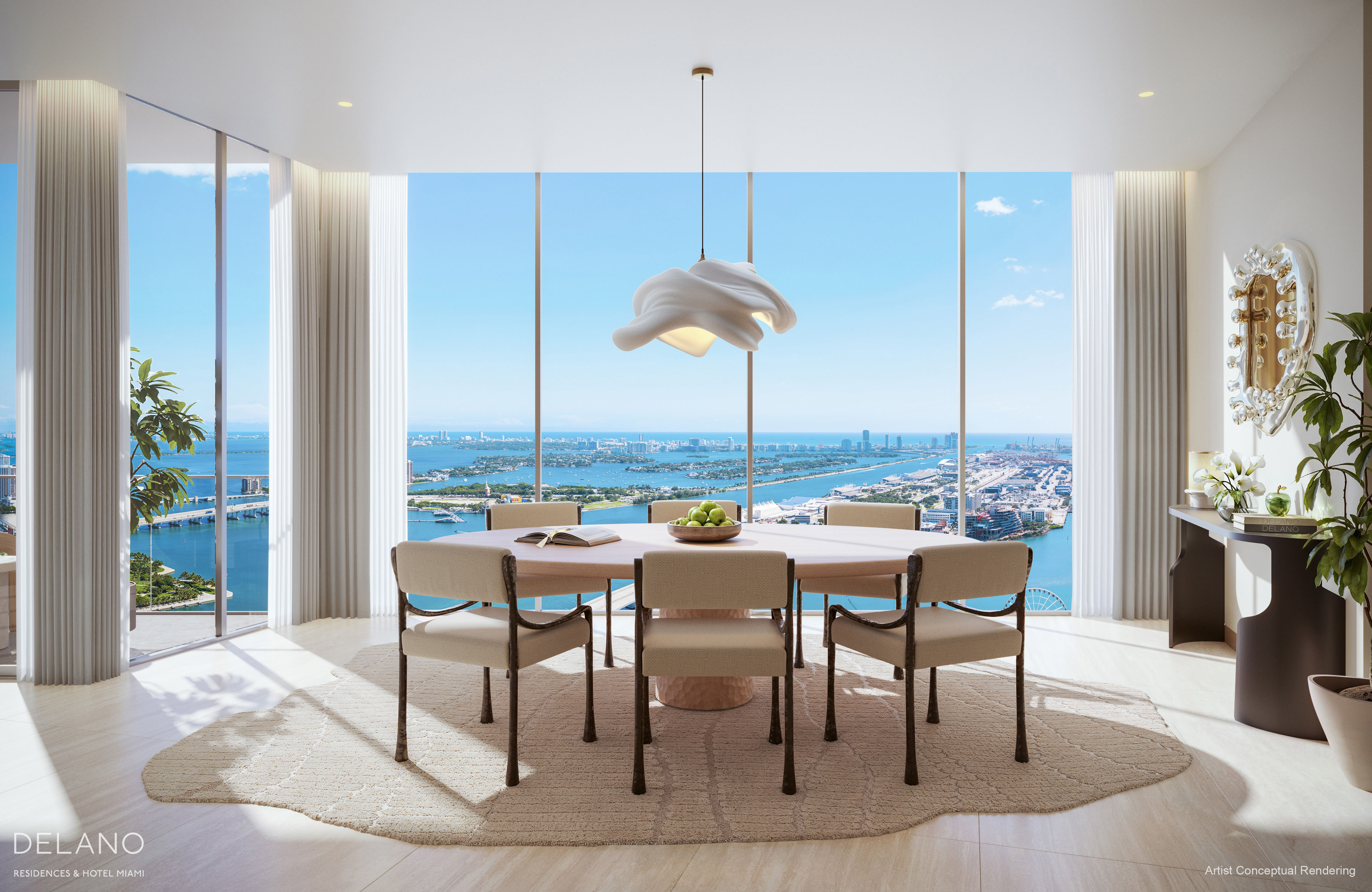
The adjacent dining room in a Residences-level unit — the kitchen and dining area designed as a single continuous volume, framed by floor-to-ceiling glass that opens onto Biscayne Bay.El comedor adyacente en una unidad de nivel Residences — la cocina y el comedor diseñados como un solo volumen continuo, enmarcado por vidrio del piso al techo que se abre a Biscayne Bay.
Waterworks and the Quiet Details
Waterworks y los Detalles Silenciosos
Impianti Idrici e i Dettagli Silenziosi
Sistemas de Água e os Detalhes Silenciosos
If Italkraft provides the room and Sub-Zero and Wolf provide the engines, the final layer of detail — the fittings that residents will touch a hundred times a day — comes from Waterworks. The American firm, founded in 1978 in Danbury, Connecticut, has become the quiet standard for high-end residential plumbing. At Delano, every kitchen faucet is specified in Waterworks's Henry collection — an unlacquered brass that will develop a patina over years of use, transforming a new apartment into a home that has, in the most genuine sense, been lived in.
Si Italkraft proporciona la habitación y Sub-Zero y Wolf proporcionan los motores, la capa final de detalle —los herrajes que los residentes tocarán cien veces al día— provienen de Waterworks. La firma estadounidense, fundada en 1978 en Danbury, Connecticut, se ha convertido en el estándar silencioso para la plomería residencial de alto nivel.
Se Italkraft fornisce la stanza e Sub-Zero e Wolf forniscono i motori, lo strato finale di dettagli — gli accessori che i residenti toccheranno cento volte al giorno — proviene da Waterworks. L'azienda americana, fondata nel 1978 a Danbury, Connecticut, è diventata lo standard discreto per l'impianto idraulico residenziale di lusso. A Delano, ogni rubinetto della cucina è specificato nella collezione Henry di Waterworks — un ottone non verniciato che svilupperà una patina nel corso degli anni di utilizzo, trasformando un nuovo appartamento in una casa che, nel senso più genuino, è stata vissuta.
Se Italkraft fornece a sala e Sub-Zero e Wolf forneceem os motores, a camada final de detalhes — os acessórios que os residentes tocarão cem vezes por dia — vem de Waterworks. A empresa americana, fundada em 1978 em Danbury, Connecticut, se tornou o padrão discreto para encanamento residencial de luxo. Em Delano, cada torneira de cozinha é especificada na coleção Henry de Waterworks — um latão sem verniz que desenvolverá uma pátina ao longo dos anos de uso, transformando um novo apartamento em uma casa que, no sentido mais genuíno, foi vivida.
"The best kitchens are the ones whose details you never notice until you try to cook somewhere else."
"Las mejores cocinas son aquellas cuyos detalles nunca notas hasta que tratas de cocinar en otro lugar."
"Le migliori cucine sono quelle i cui dettagli non noti mai finché non provi a cucinare da un'altra parte."
"As melhores cozinhas são aquelas cujos detalhes você nunca nota até tentar cozinhar em outro lugar."
There is a moment, weeks after moving into a kitchen like the one at Delano, when the logic of the room begins to reveal itself in everyday use. The drawer that opens with a gentle push rather than a handle. The undermount lighting that adjusts to the time of day without being asked. The stone that stays cool in a way that makes it impossible to imagine rolling pastry on anything else. The specific engineered silence of a Sub-Zero door closing. These are the details that distinguish a kitchen designed by people who genuinely cook from a kitchen designed to impress people who do not.
Hay un momento, semanas después de mudarse a una cocina como la de Delano, cuando la lógica de la habitación comienza a revelarse en el uso cotidiano. El cajón que se abre con un suave empujón en lugar de una manija. La iluminación que se ajusta a la hora del día sin ser solicitada.
C'è un momento, settimane dopo essersi trasferiti in una cucina come quella di Delano, quando la logica della stanza inizia a rivelarsi nell'uso quotidiano. Il cassetto che si apre con una leggera spinta piuttosto che una maniglia. L'illuminazione sottoposta che si regola all'ora del giorno senza essere chiesta. La pietra che rimane fredda in un modo che rende impossibile immaginare di stendere la pasta su qualcos'altro. Lo specifico silenzio progettato della porta Sub-Zero che si chiude. Questi sono i dettagli che distinguono una cucina progettata da persone che genuinamente cucinano da una cucina progettata per impressionare persone che non lo fanno.
Há um momento, semanas depois de se mudar para uma cozinha como a de Delano, quando a lógica da sala começa a se revelar no uso cotidiano. A gaveta que se abre com um leve empurrão em vez de uma alça. A iluminação embutida que se ajusta à hora do dia sem ser solicitada. A pedra que permanece fresca de uma forma que torna impossível imaginar estender massa em qualquer outro lugar. O silêncio engenheirado específico da porta Sub-Zero fechando. Esses são os detalhes que distinguem uma cozinha projetada por pessoas que genuinamente cozinham de uma cozinha projetada para impressionar pessoas que não o fazem.
The Room at the Center
La Habitación en el Centro
La Stanza al Centro
O Quarto no Centro
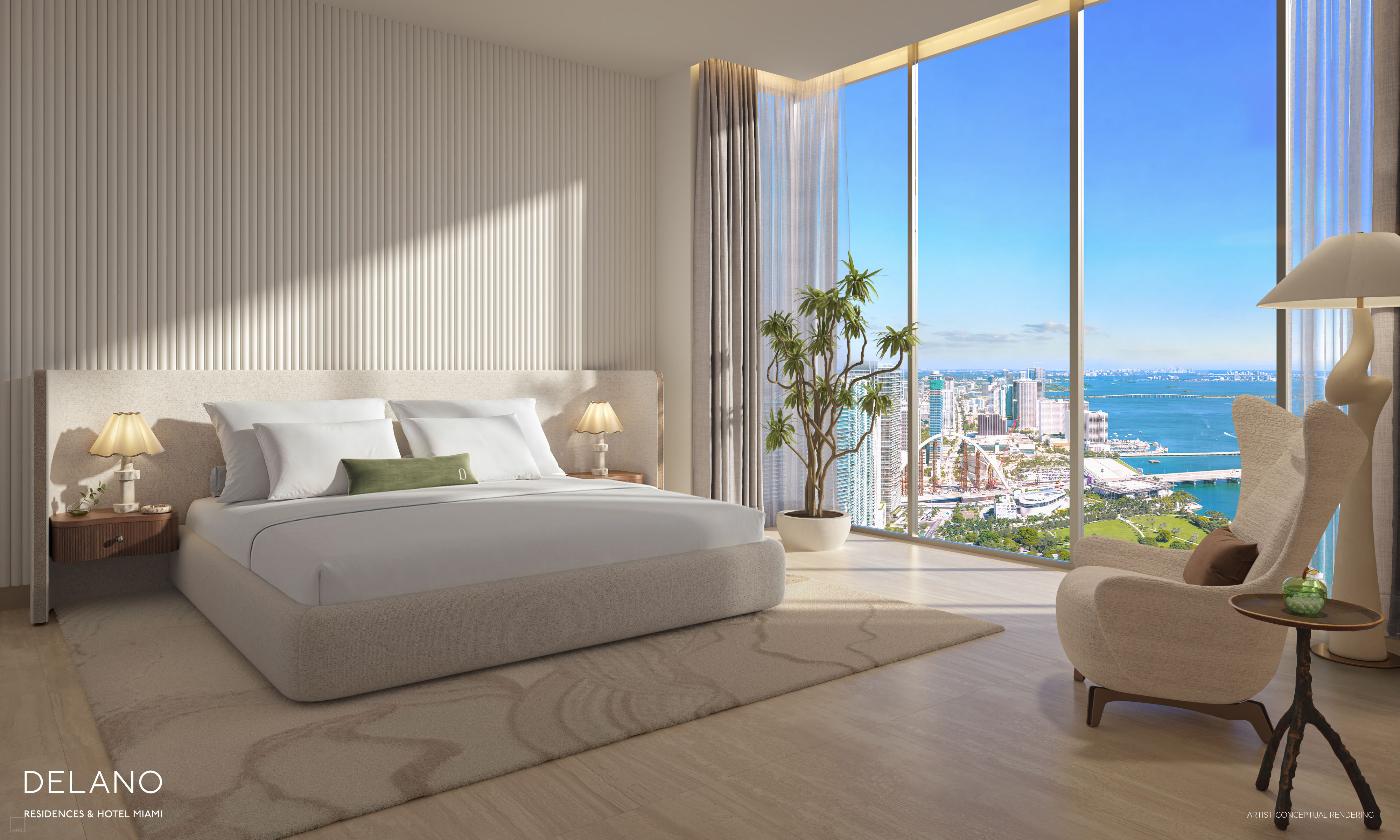
Because Delano residences are conceived as homes rather than investment properties, the kitchens have been placed — deliberately — at the social center of each floor plan. They are not tucked away as service spaces. They are not compressed to favor the view. They face outward, onto Biscayne Bay, onto the city, onto the open Atlantic — because the premise of the building is that the best moments of a great residence happen in the kitchen, and those moments deserve the best view in the house.
It is a philosophy that owes something to Italy, where the kitchen has long been the genuine heart of domestic life, and something to Miami, where the quality of light makes any hour spent in a well-designed room feel like a small ceremony. At Delano, the two traditions converge into something specific to this building and this city: a kitchen that is not a workspace but a room — perhaps the most important room in the residence.
Porque las residencias Delano son concebidas como hogares en lugar de propiedades de inversión, las cocinas han sido colocadas — deliberadamente — en el centro social de cada planta. No están escondidas como espacios de servicio. No están comprimidas para favorecer la vista. Miran hacia afuera, hacia la Bahía Biscayne, hacia la ciudad, hacia el Atlántico abierto.
È una filosofia che deve qualcosa all'Italia, dove la cucina è stata a lungo il vero cuore della vita domestica, e qualcosa a Miami, dove la qualità della luce rende ogni ora trascorsa in una stanza ben progettata come una piccola cerimonia. A Delano, le due tradizioni convergono in qualcosa di specifico per questo edificio e questa città: una cucina che non è uno spazio di lavoro ma una stanza — forse la stanza più importante della residenza.
É uma filosofia que deve algo à Itália, onde a cozinha há muito tempo é o verdadeiro coração da vida doméstica, e algo a Miami, onde a qualidade da luz torna cada hora gasta em uma sala bem projetada como uma pequena cerimônia. No Delano, as duas tradições convergem em algo específico para este edifício e esta cidade: uma cozinha que não é um espaço de trabalho mas uma sala — talvez a sala mais importante da residência.
Share this storyCompartirCondividi questa storiaCompartilhe esta história
Dora Kovacs is a licensed Florida real estate agent (License #3502193) affiliated with Keller Williams. She represents buyers and investors in Miami's most sought-after pre-construction and luxury condominium developments. Contact: dora@bnsluxury.com · (305) 781-0210 · 1000 5th St, Suite 202, Miami Beach, FL 33139.
Dora Kovacs es agente inmobiliaria licenciada en Florida (Licencia #3502193), afiliada a Keller Williams. Representa a compradores e inversionistas en los desarrollos de pre-construcción y condominios de lujo más codiciados de Miami. Contacto: dora@bnsluxury.com · (305) 781-0210 · 1000 5th St, Suite 202, Miami Beach, FL 33139.
Dora Kovacs è un agente immobiliare autorizzato dalla Florida (Licenza #3502193) affiliato a Keller Williams. Rappresenta acquirenti e investitori negli sviluppi di condomini di lusso e pre-costruzione più ricercati di Miami. Contatti: dora@bnsluxury.com · (305) 781-0210 · 1000 5th St, Suite 202, Miami Beach, FL 33139.
Dora Kovacs è un agente immobiliare autorizzato dalla Florida (Licenza #3502193) affiliato a Keller Williams. Rappresenta acquirenti e investitori negli sviluppi di condomini di lusso e pre-costruzione più ricercati di Miami. Contatti: dora@bnsluxury.com · (305) 781-0210 · 1000 5th St, Suite 202, Miami Beach, FL 33139.
Private Pricing Available
Precios Privados Disponibles
Prezzo Privato Disponibile
Preço Privado Disponível
Interested in Delano Residences?¿Interesado en Delano Residences?Interessato a Delano Residences?Interessado em Delano Residences?
Receive the full residence catalogue, current pricing, and available floor plans — delivered privately within minutes.
Reciba el catálogo completo de residencias, precios actuales y plantas disponibles — entregado en minutos.
Ricevi il catalogo completo delle residenze, i prezzi attuali e le planimetrie disponibili — consegnati privatamente in pochi minuti.
Receba o catálogo completo de residências, preços atuais e plantas disponíveis — entregues em privado em poucos minutos.
or fill manuallyo completar manualmenteo compila manualmenteou preencha manualmente
✓ Thank you. Your private pricing package is on its way.✓ Gracias. Su paquete de precios está en camino.✓ Grazie. Il tuo pacchetto di prezzo privato è in arrivo.✓ Obrigado. Seu pacote de preço privado está a caminho.